As part of the Visual Resources Task Force, a small group of us have been working on a Parkinson’s Symptom Wheel. We’ve focused in on three different concepts, and today we’re asking for your input! Which do you like best, visually and practically? Are there elements from different wheels that you think could be combined to produce a better whole? Please vote below!
First up, what is this about?
The intended user of the wheel is either a non-specialist clinician or a patient, who may not be familiar with all the lesser-known potential symptoms. The goals are two-fold: to highlight that certain symptoms may be part of PD progression, and to highlight that some of the lesser-known symptoms can have a significant impact on daily life. The hope is that this resource will prompt conversations between the patient and clinician, so that symptoms can be recognized as part of PD progression, and treated according to their importance in the patient’s life.
The three wheel concepts
The data used in each wheel are derived from the paper “Systematic review and consensus conceptual model of meaningful symptoms and functional impacts in early Parkinson’s Disease” by Mammen et al, 2025. This paper is a synthesis of multiple patient-centred assessments of both the symptoms experienced, and the level of impact of those symptoms.
Over 340 symptoms are listed, which we considered too many to include in a visual representation. Therefore one of the main challenges is to make the wheel as comprehensive as possible, while still being easily legible to the user.
Concept 1
This was produced by Ana Jimena Hernández-Medrano (@anajimenahdz), and aims to highlight as much of the spectrum of symptoms as possible, with colour used to group symptoms based on system or domain affected. The bars indicate how bothersome patients tend find each symptom, based on averages reported in Mammen et al 2025.

Concept 2
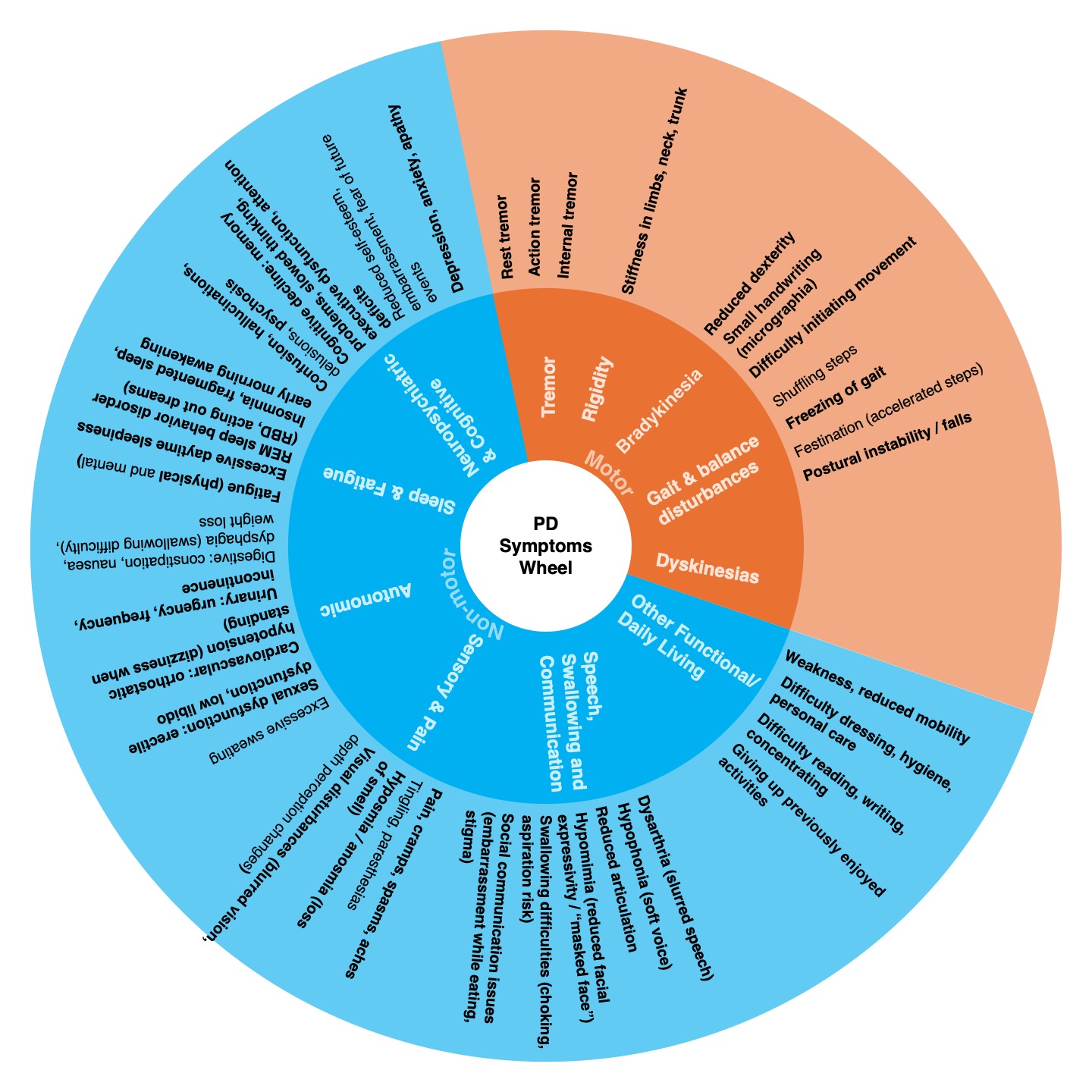
This was produced by Kobla Atsu Amewu (@ekaamewu). It uses colour to clearly distinguish between the motor and non-motor symptoms. It inverts the placement of domains and symptoms as compared to Concept 1, with the domains in the centre, which gives more space for the symptoms around the outside of the wheel.
Concept 3
This was produced by me (@vcatterson), and also uses colour to group symptoms based on the domain affected. It uses a bulls-eye concept to highlight how bothersome patients tend to find each symptom, with the most frequently problematic symptoms in the focal point, the centre. It aims to use a lay-person’s language for the symptoms, in consideration of the potential user being a patient.

The ask
Please vote for which you find most useful and appealing! And please comment below if there are particular features or aspects of each wheel that you like.
- Concept 1: Radial bar chart
- Concept 2: Simplified pie chart
- Concept 3: Bulls-eye map
We aim to synthesize all your feedback into a single version, which we will post again in the future for final comments. Thanks! 

